
Braingel
So Jaina can know her father, even if one day he's gone.
Braingel was born from an uncomfortable question: if I were gone tomorrow, what would remain of me for my daughter? Scattered photos, chats, a couple of blurry videos. Not enough. So I built something to change that.
"There are people who haven't seen their children in years. There are those who know they won't make it to summer. There are those who are starting to forget names. This is for all of them."The reason Braingel exists
There are many ways to lose someone
Terminal patients
People who know they're leaving. Who have time, but not enough to tell everything. Their stories, their worldview, the advice they'll never give in person. Braingel is the place to leave all that organized, so it remains when they're gone.
Alzheimer's and dementia
The disease erases slowly, but it erases. Before memories disappear entirely, there's a window to capture them. The name of that childhood neighbor. The story of the first job. The recipe nobody ever wrote down. The past, saved before it leaves.
Families separated by the world
Children who emigrated. Parents who stayed. Grandparents who will probably never meet their grandchildren in person. Distance does what it can, but accumulated memories — photos, stories, videos, voices — are the thread that holds when everything else fails.
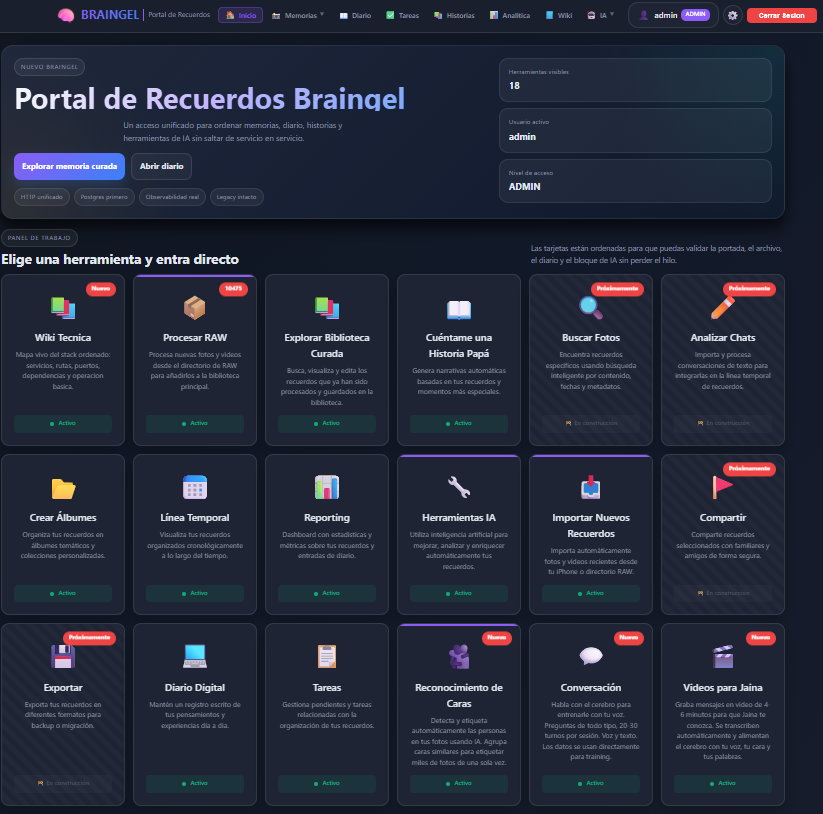
18 ways to capture who you are
The philosophy is simple: every type of interaction a human being can have to leave a trace of their emotions, way of thinking and way of being, all in one place. Photos, videos, chats, diaries, conversations, podcasts, stories. Everything counts. Everything feeds the model.
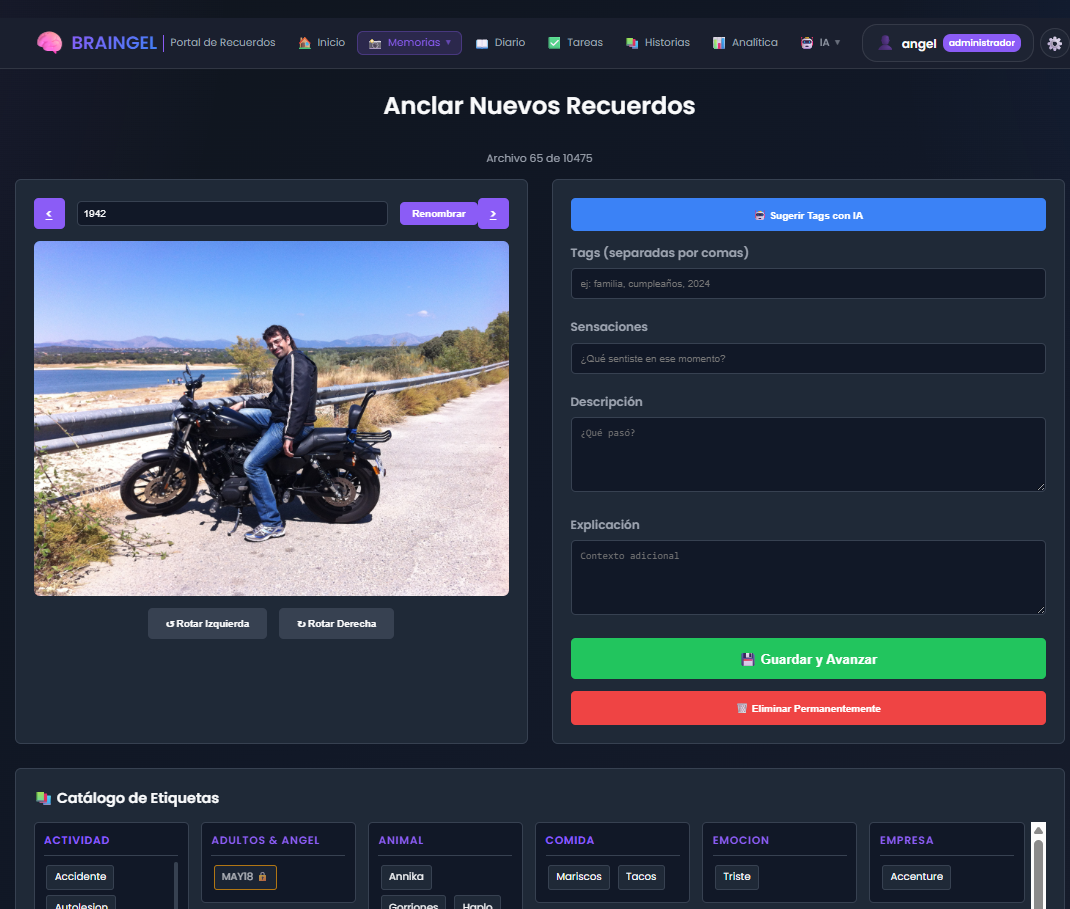
Anchoring a memory, photo by photo
We've processed over 10,475 photographs. Each one goes through the same ritual: we give it a name, add tags, tell the feeling that was there in that moment, describe what was happening, who was there. We build the narrative thread that connects events, people, places and dates.
These aren't just photos. They're the training data for a model that will need to be able to tell that life — with their own words, with their own photos, with their own places — to whoever needs to hear it most.
AI suggests tags automatically. We correct them, add context, delete what doesn't make sense. It's work. I won't lie. But it's the kind of work that's worth doing.
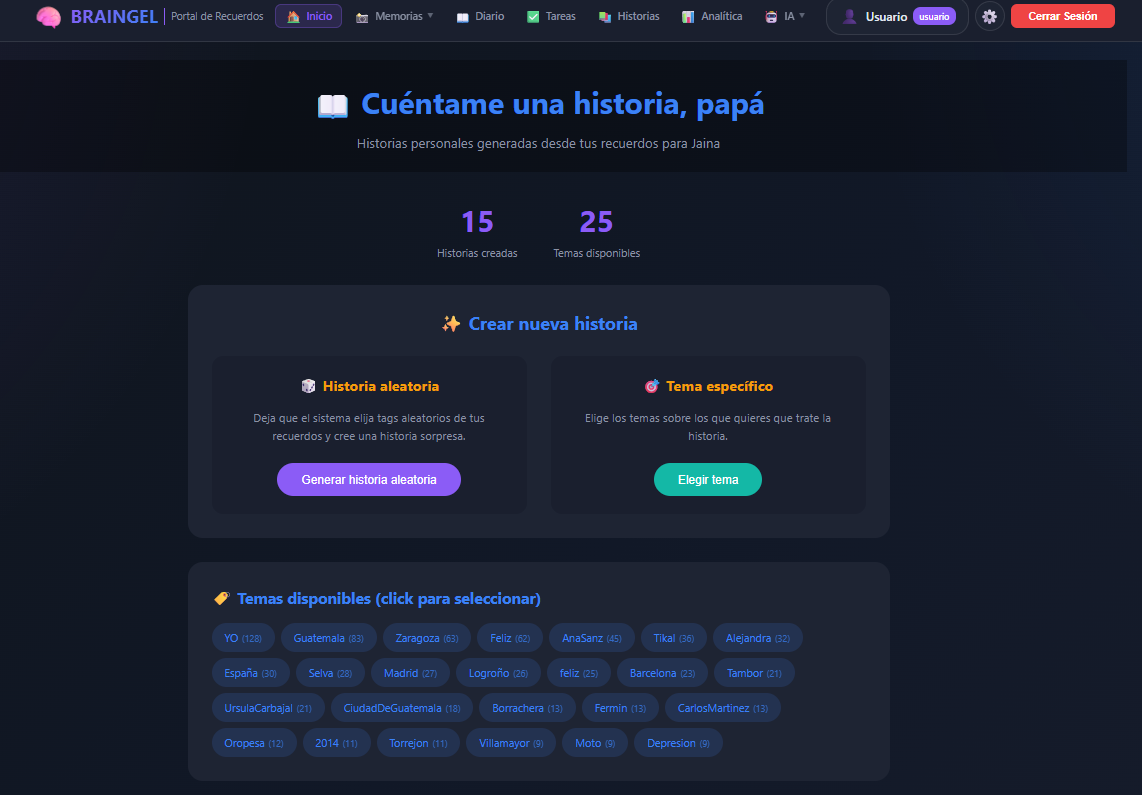
Tell me a story, Dad
The name says it all. This is what everything else is built for. An engine trained on a person's life so it can tell it — with their own words, their own photos, their own places — to whoever needs to hear it most.
Where does the information come from?
All of this is decomposed down to the most atomic level possible, consolidated and converted into the knowledge base of a model with a single objective: so Jaina can know her father better, in case he's ever gone.
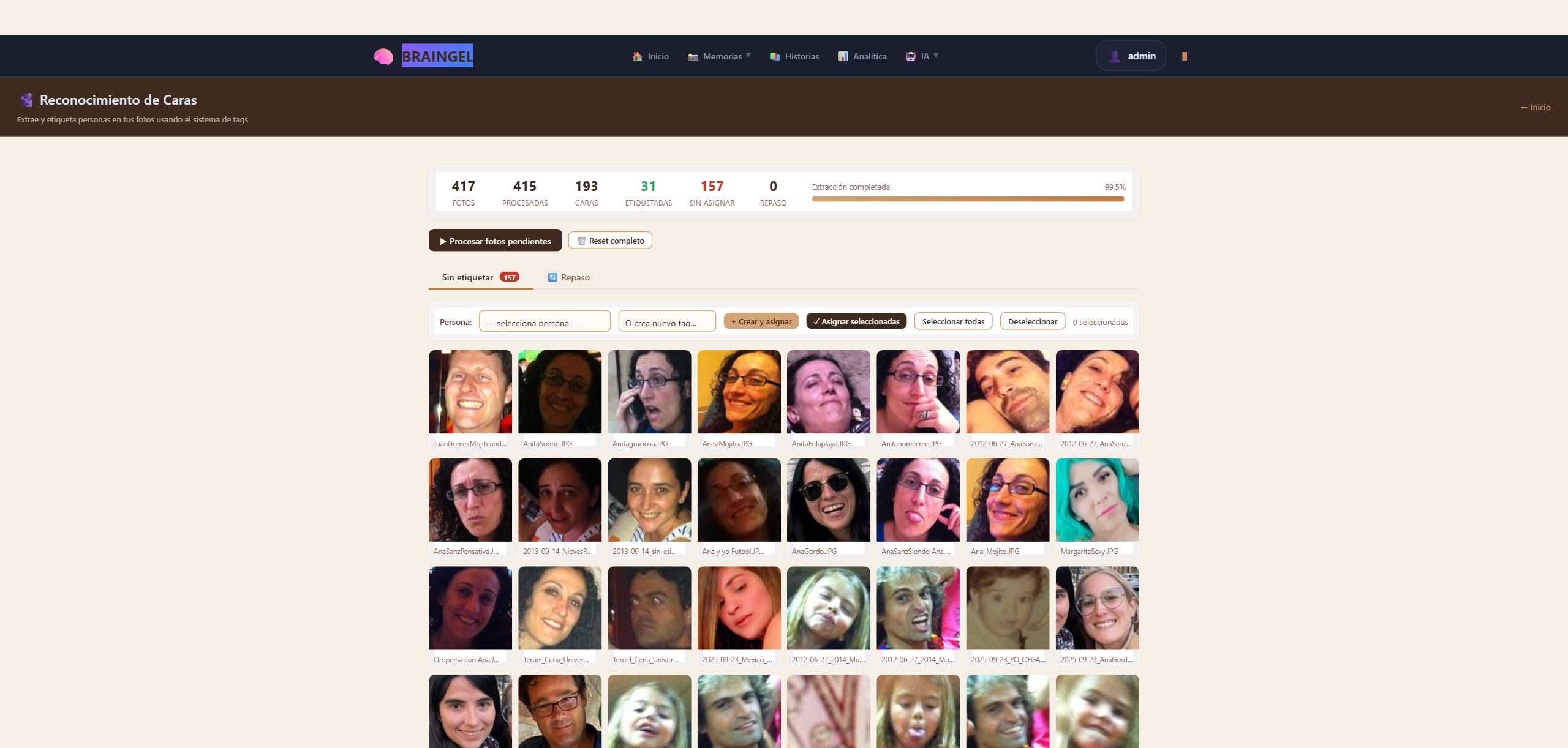
Who was there at each moment
We have a lot of information and we use artificial intelligence to at least help us interpret who appears in each photo. This accelerates the tagging process enormously and lets us build relationships between people, places and moments that would otherwise be impossible to find by hand.
The system groups all appearances of each person across thousands of files. In one click, you can see every moment someone was present. The stories write themselves.
A note about the photos: This app is private, but we are working on obtaining explicit consent from people who appear. If someone feels uncomfortable seeing themselves in a public screenshot, they can write to us at the email at the bottom of the page and we'll sort it out — either by removing the photo or, if I feel like it, putting a sticker on it.
The model that learns from you
Braingel doesn't use a generic model. It trains one specific to each person, with their voice, their memories and their way of speaking. The technology that makes this possible is called LoRA.
Personalized LoRA training
LoRA (Low-Rank Adaptation) allows adapting large language models to a specific person without needing to retrain from scratch. Every recorded conversation, every diary entry and every story told feeds an adapter that makes the model speak more and more like the person you're preserving.
Compatible models
The system supports the main open-source models: LLaMA 3, Mistral, Phi-3 and Gemma 2. All models that accept LoRA fine-tuning are candidates. Training runs locally or on cloud instances under the user's control — no data leaves to third-party servers.
Automatic daily training
Every night, Braingel processes the new entries of the day and launches an incremental training cycle. The model updates automatically with the new without losing the old. After six months of use, the model faithfully reflects the vocabulary, recurring themes and thinking style of the person.
Video and voice recording
Braingel records directly from the browser. No installations, no external apps. The person speaks to the camera — tells a memory, answers an AI question, reads a letter — and the video is saved, indexed and linked to the corresponding memories. Voice and face, preserved.
Conversations that train the model
Each AI conversation session serves two functions: it extracts memories that otherwise wouldn't have been told, and generates question-answer pairs that directly feed LoRA training. The system is designed so that using Braingel is, in itself, the training process.
Progress analytics
Control panel showing how many memories have been captured, how many hours of video accumulated, training progress and model metrics. Know at all times how complete the memory archive is and what remains to be covered.
We want to release it to the world
Braingel was born as a personal project. Not a commercial product, not a startup. As the need to preserve something that matters before it disappears.
The intention is that when the system is functional and stable, we'll release it as open source. So that any person or developer can use it, improve it, adapt it to their own circumstances. Because this problem is universal and the solution should be too.
Tell us your story
If you have someone whose memories you want to preserve, or if as a developer you want to contribute when we open the code, we'd love to hear from you.
Write to us →